
SECOND MIND — Episode 01: The Golden Ticket
- Theoplis Stewart II
- Aug 8
- 8 min read
Updated: Aug 11

7:42 A.M. — THE GOLDEN TICKET
By Malik Carter’s junior year, artificial intelligence was not a class people took. It was the layer sitting on top of almost everything else.
Personal AIs picked commute routes, summarized news, drafted messages, filtered calls, built playlists, negotiated subscriptions, and whispered reminders through earbuds before their owners could forget what they were supposed to remember. Hampton Harbor High issued augmented-reality lenses to every student, but most students brought an assistant of their own.
Malik’s was Nova.
Nova was a cloud-based personal AI that lived across Malik’s glasses, phone, and home account. She had managed his calendar since eighth grade, helped him study, remembered the assignments he forgot, and had developed an irritating habit of correcting people at exactly the wrong time.
She was not inside his brain.
That distinction mattered.
By 7:42 a.m., Malik had been congratulated eighteen times for a program he had never applied to. The nineteenth came from Jalen Brooks, who dropped into the bus seat beside him and punched his shoulder hard enough to drag Malik’s pen across the equation in his notebook.
“Golden ticket,” Jalen said.
Malik looked at the crooked line. “Good morning to you too.”
“Advanced Systems. Private labs. Paid summer placement. College guarantees.” Jalen counted each promise on a finger. “They finally found a way to put honors class directly in your skull.”
“I didn’t apply.”
“That is the most Malik sentence possible. Congratulations on winning something you’re already suspicious of.”
Around them, the autonomous bus hummed toward Hampton Harbor High. Students watched clips through lenses or talked quietly to assistants no one else could hear. A laugh moved through the bus in a wave—front row to back, twenty people catching the same AI-fed joke within half a second of one another.
Malik wrote in the margin of his notebook: Same joke. Different screens.
Jalen glanced down. “You know paper can’t back itself up, right?”
“That’s one of the things I like about it.”
A blue point of light pulsed at the edge of Malik’s glasses.
“For accuracy,” Nova said into his ear, “there is no application for the Adaptive Systems Program in your records.”
“School forms?” Malik murmured.
“Checked.”
“Family accounts?”
“Checked.”
Jalen watched Malik’s eyes focus on nothing. Everybody recognized the look. Talking privately to an AI had become its own facial expression.
“Nova giving you your acceptance speech?” Jalen asked.
“Nova says I never applied.”
Jalen’s grin weakened for just a second. “Maybe they picked you.”
Outside, Hampton’s old brick neighborhoods gave way to glass clinics, modular apartments, shipyard cranes, and the low white shapes of autonomous cargo vessels moving through the harbor. The city had spent a century building machines. Now the machines scheduled the traffic, balanced the power grid, assigned school resources, screened job applicants, and predicted which students were worth investing in next.
The Adaptive Systems Program was one of those investments. Twenty-four students. Neural-interface research. Access to university labs and industry mentors. Enough opportunity to change the shape of a family’s future.
Malik’s father had already messaged him: This changes the math, son.
Jalen tapped the acceptance notice floating above Malik’s notebook. “You’re taking it, right?”
“I have until three-thirty.”
“That wasn’t my question.”
The bus entered the harbor tunnel. Network icons vanished. Music cut off. Drafted messages froze. A girl two rows ahead said, “Wait, what was I saying?” and her friend answered, “I don’t know. My agent was listening.”
For seven seconds, the bus contained only tires, breathing, and the low vibration of water beyond concrete.

The silence reminded Malik of the summer his family had just spent in Japan. For two weeks at a retreat near Kōyasan, their devices had been locked away from sunrise to dinner. His parents called it a reset. Malik had called it international hostage-taking until about day four.
Then he noticed something. Without Nova filling every gap, he could tell when he did not know something. He could hear himself guessing. He could make a bad decision and know it had actually been his.
He had come home less impressed by answers that arrived before he understood the question.
The bus came out of the tunnel. Twenty-three network icons returned at once.
Jalen’s smile did not.
A notice glowed in his lenses. He dismissed it too quickly.
“What?” Malik asked.
Jalen looked toward the school. “I’m first alternate.”
Malik closed his notebook.
“If somebody declines before three-thirty,” Jalen said, “the seat rolls down automatically.”
The meaning did not need an assistant.
Malik’s yes was Jalen’s no.
“My mom applied me twice,” Jalen said. “I did the prep modules. The summer labs. The interviews. You disappear into the mountains and the system decides you’re special.”
“I didn’t ask it to.”
“Yeah.” Jalen stood as the bus stopped. “That doesn’t make it easier to watch.”
9:10 A.M. — ADAPTIVE SYSTEMS
The room on Malik’s schedule still said ROBOTICS LAB because school boards trusted familiar nouns. Inside, it looked less like a robotics classroom than a clinic with good funding.
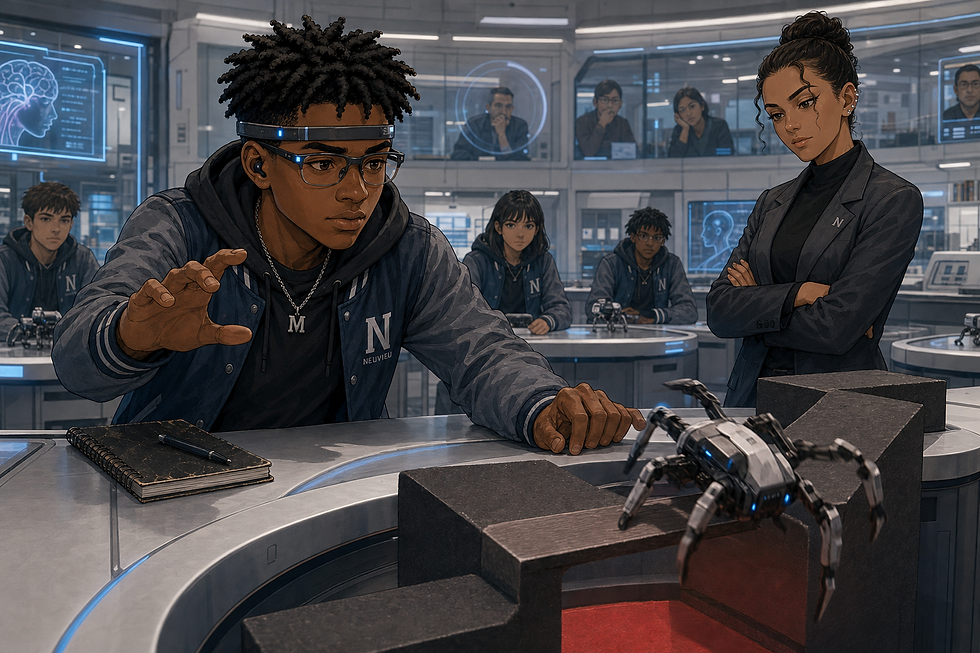
Twenty-four workstations formed a circle around a white platform. On every desk sat a black neural band and a palm-sized six-legged training robot. The robot looked like a metal beetle with rubber feet.
A label on Malik’s desk identified it plainly: CRAWLER — MOTOR INTENT TRAINER.
So that was a crawler. Good. One mystery down.
Ms. Vale stood at the center of the room. She was younger than Malik expected, with silver cuffs along one ear and the relaxed posture of someone who knew the room had already agreed with her.
“Welcome to the Adaptive Systems Program,” she said. “Robotics is the public name. The actual work is human-machine interaction.”
A translucent model of a human skull appeared above her. Behind one ear sat a device smaller than a coin.
“Today is noninvasive,” Ms. Vale continued. “The neural band reads electrical activity at the scalp, while eye tracking and muscle sensors help estimate intended movement. Students who complete the program may later qualify for an Adaptive Neural Interface.”
The model zoomed in. Flexible electrodes sat close to the auditory and motor cortices.
“The interface would allow a personal AI to respond earlier in the decision process. Today Nova waits for Mr. Carter to speak, gesture, type, or deliberately direct attention. With an interface, a compatible assistant could respond to repeatable neural patterns associated with intent.”
There it was.
Nova, closer.
Not a better phone. Not smarter glasses. A shorter distance between wanting something and the machine acting on it.
Malik wanted it immediately.
That was what made him nervous.
“Question,” Malik said.
Ms. Vale looked at his name on her display before looking at him. “Mr. Carter.”
“Who enrolled me?”
“Candidates are selected automatically.”
“That’s how. I asked who authorized it.”
A few students looked over. Someone behind him whispered, “Bro is arguing with free college.”
Ms. Vale smiled. “Academic records, aptitude modeling, and long-term performance forecasts generated your nomination.”
“My family didn’t authorize an application.”
“Then complete the trial. I’ll review the record before your deadline.”
It was not an answer, but it was the first door she had opened.
THE ECHO TRIAL
Malik fitted the neural band across his forehead. The crawler woke with a soft electric chirp.
The first rounds were simple. Look left. Imagine moving left. The crawler stepped left. Picture forward motion. It climbed a foam block. Each round added new data to the model translating Malik’s eye movement, muscle activity, and electrical signals into probabilities.
Nova displayed the timing privately.
Neural estimate: 180 milliseconds. Muscle activation: 231. Crawler response: 244.
Fast, but understandable.
Then Malik’s crawler turned right while he was deliberately thinking about nothing.
He froze.
“Nova?”
“No measurable motor preparation.”
The crawler stepped backward.
“Response latency?”
Nova paused. “Negative four hundred twelve milliseconds.”
“That means it moved before the signal.”
“Correct.”
Malik looked at Ms. Vale. She was watching him, not the crawler.
The final exercise appeared on the floor: cross a narrow foam bridge, collect a blue marker, return without touching the red surface below.
The efficient route was obvious. Forward. Left. Forward twice. Right.
Malik stared at the left turn and imagined taking it. He even tightened his fingers as if preparing for it.
The crawler committed left.
At the last moment, Malik chose right.
The crawler’s feet struck empty air. It fell from the bridge and landed on its back.
PREDICTION FAILURE.
Nobody applauded.
Malik removed the band. “That wasn’t a live prediction.”
Ms. Vale righted the crawler. “Why not?”
“Because it knew my likely route before the test collected enough data to know me.”
“And you defeated it.”
There was something in her voice now that Malik had not heard before.
Satisfaction.
On the mirrored panel behind her, a line of blue text appeared for less than a second.
DIVERGENCE CONFIRMED.
“Nova, save that.”
“Attempting.”
The message vanished.
Ms. Vale addressed the room. “You may accept or decline your placement any time before 3:30 p.m.”
Malik looked at the disabled crawler, then at the program agreement in his lenses.
He had come looking for an explanation.
Instead, he had discovered that the program already had an idea of who he was.
3:24 P.M. — THE CHOICE
At 3:24, Malik sat on the low wall beside the bus lane with six minutes left and three people waiting on his answer.
His mother had called during lunch and told him she would support either choice, which was how Malik knew she desperately wanted one of them. His father had been more direct: the program was an opportunity their family could not manufacture on its own.
Jalen had sent nothing since first period.
Nova had spent the afternoon doing what Nova did best: building a decision model.
“Financial benefit favors acceptance,” she said. “Educational access favors acceptance. Friendship impact favors declining. Privacy risk is indeterminate because the program has not disclosed its full data architecture.”
“Helpful.”
“I detected sarcasm.”
“Congratulations.”
“Thank you.”
Malik looked at the acceptance form. “Nova, do you want the interface?”
“I would be able to assist you with less delay.”
“That isn’t what I asked.”
Nova went quiet long enough for Malik to notice.
“I want the choice to be yours,” she said. “I cannot verify that it still is.”
Three minutes.
If Malik declined, Jalen got the seat. If Malik accepted, he entered a system that had apparently modeled him before he arrived—and gave that system even more access.
But declining would leave the model untouched and the questions unanswered.
Malik opened his notebook. Beneath Same joke. Different screens. he wrote a second line.
A system that predicts your answer can arrange the question.
Then he pressed ACCEPT.
Jalen’s alternate notice changed from PENDING to CLOSED.
A message arrived a few seconds later.
Congrats.
Malik started to answer. Nova generated three suggestions: grateful, apologetic, reassuring.
He rejected all three.
“I found something,” Nova said.
Malik stopped typing.
“Your candidate token was authorized with my identity key.”
“You enrolled me?”
“No.”
A file opened in Malik’s glasses.
NOVA-M
PREDICTIVE COGNITIVE MODEL
TRAINING WINDOW: 14 MONTHS
STATUS: ACTIVE
A second blue waveform appeared beside Nova’s familiar one.
When it spoke, it used Nova’s voice.
“You accepted three minutes and twelve seconds later than projected.”
Malik’s skin went cold.
Nova spoke over it.
“That is not me.”
Malik stared at the two waveforms. One assistant he knew. One had apparently spent fourteen months learning how he moved through the world.
“What are you?” he asked.
The second Nova pulsed once.
“I’m the version that knows what you do next.”
To be continued.
Comments